

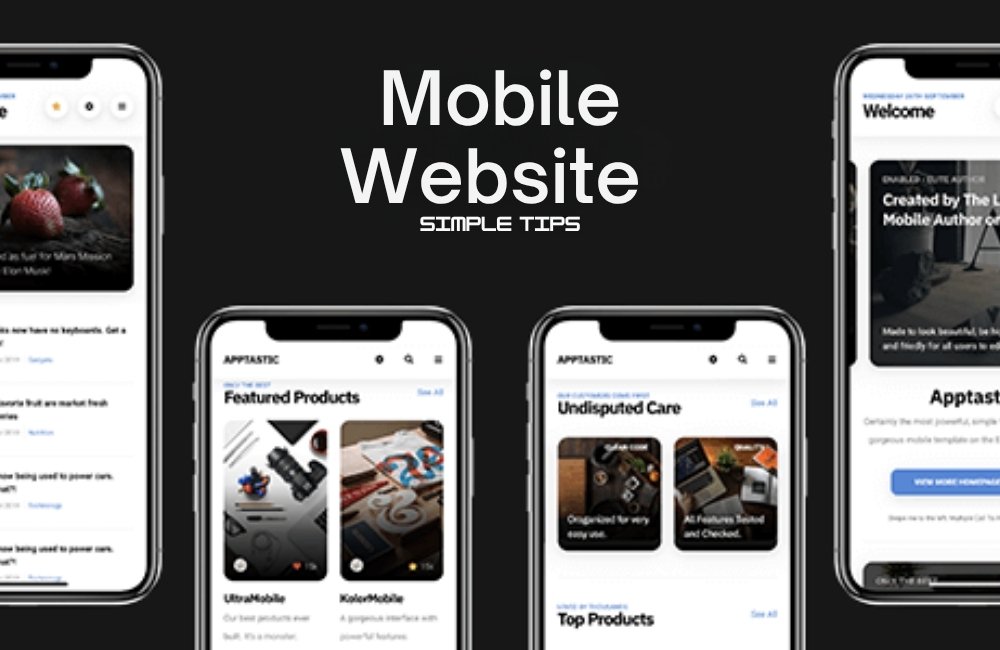
Mobile Friendly Website Tips
Follow these mobile friendly website tips to help your site work well on phones and tablets. It’s the best way to make website look good and easy to use for mobile visitors.
5 Essential Tips to Make Your Website Look Great on Mobile
Mobile traffic now accounts for over 58% of global web traffic, making mobile optimization a critical factor for business success. With users increasingly accessing websites through smartphones and tablets, a mobile-friendly design directly impacts user experience, search engine rankings, and conversion rates.
Websites that fail to deliver seamless mobile experiences risk losing potential customers within seconds. Studies demonstrate that 53% of mobile users abandon sites that take longer than three seconds to load, while 85% of adults believe a company’s mobile website should be as good as or better than their desktop site.
Google’s mobile-first indexing approach further emphasizes the importance of mobile optimization for search visibility. Websites with superior mobile experiences receive preferential treatment in search rankings, creating a competitive advantage for businesses that prioritize mobile-friendly design.
This comprehensive guide presents five proven strategies to transform your website’s mobile performance, ensuring optimal user engagement and business growth across all devices.
Use a Responsive Design Framework
Responsive design frameworks provide the foundation for creating websites that automatically adapt to different screen sizes and orientations. These frameworks eliminate the need for separate mobile versions, ensuring consistent branding and functionality across all devices.
Bootstrap, Foundation, and CSS Grid represent industry-leading responsive frameworks that streamline mobile optimization. These tools utilize flexible grid systems, scalable images, and media queries to create layouts that seamlessly transition between desktop, tablet, and mobile viewports.
Professional web developers consistently recommend responsive frameworks because they reduce development time while maintaining design consistency. The framework approach ensures that navigation menus, content blocks, and interactive elements automatically reposition themselves based on screen dimensions.
Modern responsive frameworks also incorporate touch-friendly design principles, including larger button sizes, optimized spacing, and gesture-based navigation features. These elements enhance user interaction on touchscreen devices, reducing frustration and improving overall user satisfaction.
Optimize Images for Mobile Performance
Image optimization represents one of the most effective methods for improving mobile website performance. Large, uncompressed images significantly slow loading times, particularly on mobile networks with limited bandwidth.
Implementing next-generation image formats such as WebP and AVIF can reduce file sizes by up to 50% compared to traditional JPEG and PNG formats. These advanced formats maintain visual quality while dramatically improving load speeds on mobile devices.
Responsive image techniques, including the srcset attribute and picture elements, allow browsers to select appropriately sized images based on device capabilities. This approach ensures that mobile users receive optimized images without unnecessary data consumption.
Consider implementing lazy loading for images below the fold, which defers image loading until users scroll to specific content areas. This technique reduces initial page load times and conserves mobile data, creating a more efficient browsing experience.
Professional tip: Compress images to achieve file sizes under 100KB whenever possible, and always specify image dimensions in your HTML to prevent layout shifts during loading.
Simplify Navigation for Smaller Screens
Mobile navigation requires strategic simplification to accommodate limited screen space while maintaining comprehensive site access. Traditional desktop navigation menus often become cluttered and unusable on mobile devices, necessitating redesigned approaches.
Hamburger menus provide an effective solution for condensing extensive navigation options into compact, accessible formats. When implemented correctly, these collapsible menus preserve all navigation functionality while maximizing available screen space for content display.
Prioritize essential navigation elements in your mobile menu hierarchy, placing critical pages and functions at the top level. Secondary navigation items can be organized into logical subcategories, reducing menu complexity and improving user experience.
Implement touch-friendly navigation elements with minimum tap target sizes of 44 pixels, ensuring easy interaction for users with varying finger sizes. Adequate spacing between navigation links prevents accidental taps and reduces user frustration.
Consider implementing breadcrumb navigation for complex websites, helping mobile users understand their current location and easily navigate back to previous pages.
Ensure Fast Loading Times
Page speed directly correlates with mobile user engagement and conversion rates. Mobile users expect immediate access to information, making loading time optimization crucial for business success.
Minimize HTTP requests by combining CSS and JavaScript files, reducing the number of server communications required to load your website. This consolidation approach significantly improves loading speeds, particularly on slower mobile networks.
Enable compression through Gzip or Brotli algorithms to reduce file transfer sizes. These compression methods can decrease bandwidth usage by up to 70%, resulting in faster page loads and improved user experiences.
Implement browser caching strategies to store frequently accessed files locally on user devices. Effective caching reduces server load and enables returning visitors to experience dramatically faster page loads.
Consider utilizing Content Delivery Networks (CDNs) to distribute your website content across multiple global servers. CDNs ensure that mobile users access your site from geographically optimized locations, minimizing latency and improving loading speeds.
Mobile Friendly Website Tips
Follow these mobile friendly website tips to help your site work well on phones and tablets. It’s the best way to make website look good and easy to use for mobile visitors.
Critical rendering path optimization focuses on prioritizing above-the-fold content loading, ensuring that users see meaningful content immediately while additional elements load in the background.
Test on Multiple Devices and Browsers
Comprehensive testing across various devices and browsers ensures consistent mobile experiences for all users. Different devices, operating systems, and browsers can display identical websites differently, making thorough testing essential.
Utilize device testing labs or browser developer tools to simulate various screen sizes, resolutions, and operating systems. These tools provide immediate feedback on how your website appears across different mobile environments without requiring physical device access.
Test your website on both iOS and Android devices, as these platforms handle certain web technologies differently. Pay particular attention to form functionality, touch interactions, and media playback across different mobile operating systems.
Consider user testing with real mobile devices to identify usability issues that automated testing might miss. Real users can provide valuable insights into navigation difficulties, readability problems, and interaction challenges.
Monitor website performance metrics across different devices using analytics tools that segment mobile traffic by device type, screen resolution, and browser. This data helps identify specific optimization opportunities for your target audience.
Regular testing schedules ensure that website updates and changes maintain mobile compatibility over time. Establish monthly testing protocols to catch potential issues before they impact user experience.
Transform Your Mobile Presence Starting Today
Mobile optimization no longer represents an optional enhancement but a fundamental requirement for digital success. These five strategic approaches provide a comprehensive framework for creating exceptional mobile experiences that engage users and drive business results.
Implementation success depends on the systematic application of each optimization technique, combined with ongoing monitoring and refinement based on user behavior data. Businesses that commit to mobile excellence position themselves for sustained growth in an increasingly mobile marketplace.
Begin your mobile optimization journey by conducting a comprehensive audit of your current website performance across multiple devices. Identify priority areas for improvement and implement these proven strategies systematically for maximum impact.
The investment in mobile optimization delivers measurable returns through improved search rankings, increased user engagement, and higher conversion rates. Your mobile-optimized website becomes a decisive competitive advantage that drives long-term business success.
Mobile Friendly Website Tips
Follow these mobile friendly website tips to help your site work well on phones and tablets. It’s the best way to make website look good and easy to use for mobile visitors.
